
Synchronise
and collaborate.
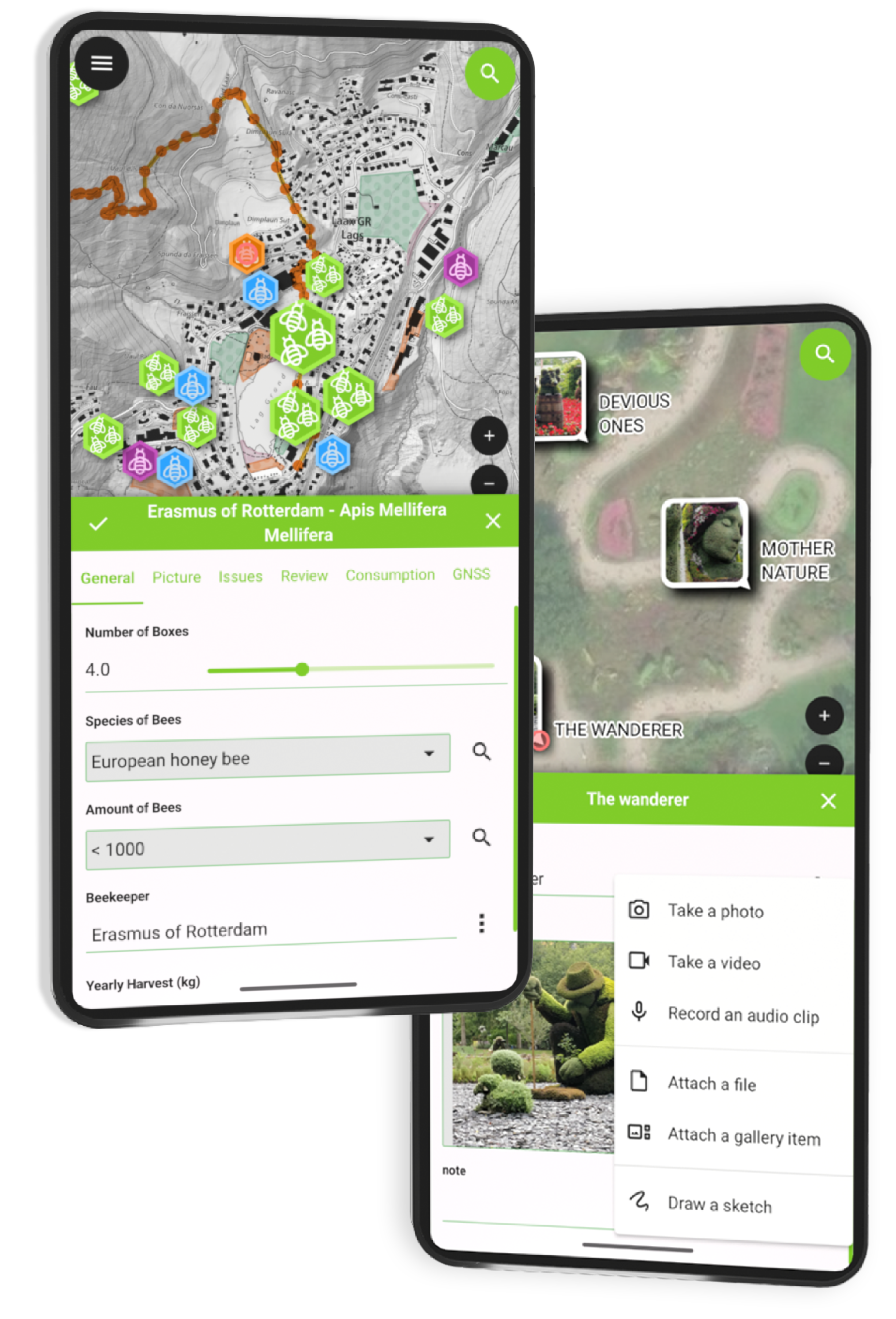
Collect
and edit data.

QFieldCloud allows to synchronize and merge the data collected by your team in QField. From small individual projects to large data collection campaigns, QFieldCloud removes the pain from synchronizing and merging data.

Sync projects and data in real time and work with GeoPackages, KML, GPX, georeferenced PDFs, and more.

Create rich survey forms with constraints, logic, defaults, and validations — all in QGIS.

Working in the wild ? You can continue to work seamlessly with QFieldCloud, and sync back your changes once you're back in town.

QFieldCloud perfectly integrates and extends your QGIS based geodata infrastructure.

Subscribe for a worry-free Swiss-made solution hosted on Swiss datacenters or contact us for your private cloud instance.

QFieldCloud code is open source so you can see what is actually happening to your data.
Let QFieldCoud manage it. Accurately, efficiently, and anywhere it matters. Get started now
Do not use angular tolerance for a 5mm short side on a 2-meter beam. Convert the angular tolerance to linear deviation (arc length = angle in radians × length) to see if it's realistic.
is an international standard created by the International Organization for Standardization that defines general tolerances for dimensions and geometry. It is used to simplify the process of documenting drawings for parts manufactured by machining or conventional methods. iso 2768 general tolerances pdf exclusive
In conclusion, the ISO 2768 general tolerances PDF is a comprehensive guide to the general tolerances for various types of dimensions. The standard provides a framework for defining the acceptable limits of variation in the dimensions of parts and components, ensuring that they can be manufactured and assembled with a high degree of accuracy. The exclusive use of the ISO 2768 general tolerances PDF ensures accuracy, interchangeability, and reduced errors, making it an essential document for engineers, designers, and manufacturers. Do not use angular tolerance for a 5mm
"It's about cost, Leo," Elias explained, his voice echoing in the quiet vault. "If we aim for when 'medium' works, we burn money. If we accept 'coarse' when the assembly needs 'fine' , we burn the mission.". It is used to simplify the process of
Saves design time since engineers do not need to calculate individual tolerances for non-critical features.
Note: For nominal sizes below 0.5 mm, deviations must be indicated directly adjacent to the relevant size. For angular dimensions, the table applies to the shorter side of the angle, and it controls only orientation, not form deviations.
For a complete set of tables including angularity and run-out, you can access these technical PDF guides from industry leaders: ISO 2768 Full Guide Dimensional Tolerance Chart Comprehensive Machining PDF DAU Components perpendicularity ISO 2768-2






Do not use angular tolerance for a 5mm short side on a 2-meter beam. Convert the angular tolerance to linear deviation (arc length = angle in radians × length) to see if it's realistic.
is an international standard created by the International Organization for Standardization that defines general tolerances for dimensions and geometry. It is used to simplify the process of documenting drawings for parts manufactured by machining or conventional methods.
In conclusion, the ISO 2768 general tolerances PDF is a comprehensive guide to the general tolerances for various types of dimensions. The standard provides a framework for defining the acceptable limits of variation in the dimensions of parts and components, ensuring that they can be manufactured and assembled with a high degree of accuracy. The exclusive use of the ISO 2768 general tolerances PDF ensures accuracy, interchangeability, and reduced errors, making it an essential document for engineers, designers, and manufacturers.
"It's about cost, Leo," Elias explained, his voice echoing in the quiet vault. "If we aim for when 'medium' works, we burn money. If we accept 'coarse' when the assembly needs 'fine' , we burn the mission.".
Saves design time since engineers do not need to calculate individual tolerances for non-critical features.
Note: For nominal sizes below 0.5 mm, deviations must be indicated directly adjacent to the relevant size. For angular dimensions, the table applies to the shorter side of the angle, and it controls only orientation, not form deviations.
For a complete set of tables including angularity and run-out, you can access these technical PDF guides from industry leaders: ISO 2768 Full Guide Dimensional Tolerance Chart Comprehensive Machining PDF DAU Components perpendicularity ISO 2768-2