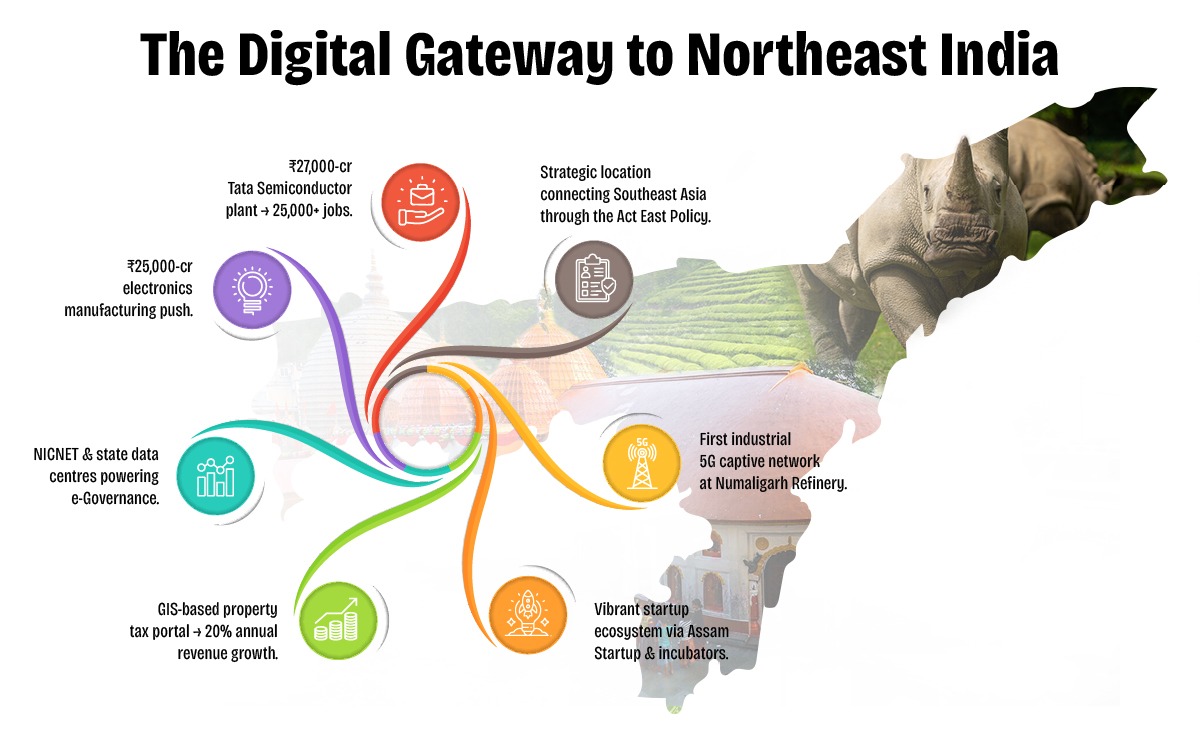
Assam is rapidly emerging as a digital innovation hub in Northeast India, driven by visionary policies and proactive governance under the Digital Assam initiative. With a growing IT ecosystem, expanding digital infrastructure, and a strong focus on e-Governance, the state is positioning itself at the forefront of India's digital transformation.
To further accelerate this journey, Elets Technomedia, in collaboration with the Information Technology Department, Government of Assam, is organising the National Digital Innovation Summit 2025 on 5-6 December in Guwahati. The summit will provide a platform for policymakers, industry leaders, innovators, and technologists to deliberate on strategies to advance the state's digital progress.

Sessions

Dynamic Speakers

of Special eGov Magazine

featuring cutting-edge solutions

Networking
An Initiative By

Knowledge Partner

Host Partner

Supporting Partner

Powered By

Banking Partner

Gold Partners


Digital Transformation Partner

Secured Communications Technology Partner

Associate Banking Partner

Technology Partner

Data Center Partner

E-Governance Partner

Branding Partners




Supporting Partners



The evolution of Malayalam cinema’s approach to romance and relationships mirrors the socio-cultural shifts of Kerala society. While early cinema relied on idealized, melodramatic love stories, contemporary Malayalam filmmakers dismantle these tropes to explore realistic, complex, and sometimes uncomfortable relationship dynamics. The Golden Era: Idealism and Tragic Romance
Malayalam cinema's approach to love stands out in the global film landscape due to several defining elements:
Filmmakers swapped dramatic rain sequences and dream songs for quiet coffee shop talks and shared silent moments. 4. Key Themes in Contemporary Malayalam Film Relationships
Frustrated, Unni slumped onto a bench near the college ground, where his friend Meera found him.
The 1990s saw the rise of the "family entertainer" starring the Big Ms—Mohanlal and Mammootty. Here, romantic storylines took a backseat to familial honor. Yet, hidden in films like Kilukkam (1991) and Godfather (1991), the romance was defined by .
“In Kumbalangi , Saji doesn’t win over Baby with a guitar solo. He learns to express his feelings honestly, even when it’s awkward. Real love isn’t a monologue—it’s a messy, honest conversation.”
The 1980s and 1990s are widely considered the golden age of Malayalam cinema. This period struck a perfect balance between artistic realism and commercial entertainment. Romantic storylines became more relatable, moving into middle-class households, college campuses, and rural landscapes.
Their relationship highlights a core tenet of Malayalam realism: Sometimes, societal pressure and family honor suffocate love until it gasps for air. The climax, where Rameshan looks at the ruined Sethu through a glass window, remains one of the most painful depictions of a relationship destroyed by circumstance.
Digital Transformation in Governance
Startups, Innovations & Entrepreneurial Growth in Northeast India
Artificial Intelligence (AI) for Inclusive Growth
Cloud, Data & Cybersecurity for a Secure Digital Future
Digital Infrastructure & Connectivity in Northeast India
Skilling, Capacity Building & Future Workforce Development
E-Governance & Citizen-Centric Service Delivery
The evolution of Malayalam cinema’s approach to romance and relationships mirrors the socio-cultural shifts of Kerala society. While early cinema relied on idealized, melodramatic love stories, contemporary Malayalam filmmakers dismantle these tropes to explore realistic, complex, and sometimes uncomfortable relationship dynamics. The Golden Era: Idealism and Tragic Romance
Malayalam cinema's approach to love stands out in the global film landscape due to several defining elements:
Filmmakers swapped dramatic rain sequences and dream songs for quiet coffee shop talks and shared silent moments. 4. Key Themes in Contemporary Malayalam Film Relationships
Frustrated, Unni slumped onto a bench near the college ground, where his friend Meera found him.
The 1990s saw the rise of the "family entertainer" starring the Big Ms—Mohanlal and Mammootty. Here, romantic storylines took a backseat to familial honor. Yet, hidden in films like Kilukkam (1991) and Godfather (1991), the romance was defined by .
“In Kumbalangi , Saji doesn’t win over Baby with a guitar solo. He learns to express his feelings honestly, even when it’s awkward. Real love isn’t a monologue—it’s a messy, honest conversation.”
The 1980s and 1990s are widely considered the golden age of Malayalam cinema. This period struck a perfect balance between artistic realism and commercial entertainment. Romantic storylines became more relatable, moving into middle-class households, college campuses, and rural landscapes.
Their relationship highlights a core tenet of Malayalam realism: Sometimes, societal pressure and family honor suffocate love until it gasps for air. The climax, where Rameshan looks at the ruined Sethu through a glass window, remains one of the most painful depictions of a relationship destroyed by circumstance.

















































& many more...
Ritika Srivastava
+91- 9990108973Anuj Sharma
+91- 8860651650
© 2026 Frontier & Canvas. All rights reserved.
Elets Technomedia, a leading technology research and media organisation, has established a robust global presence since 2003, expanding across India, Malaysia, Sri Lanka, Bangladesh, the UK, the Middle East, and beyond. Driven by a vision to explore new frontiers in tech-led innovation for a better world, Elets pioneers impactful knowledge-sharing platforms, including global conferences, webinars, and research-driven publications. Bringing together the finest policymakers and industry leaders, Elets creates impactful synergies to drive a future-ready world.



COPYRIGHT © 2025. ALL RIGHTS RESERVED BY ELETS TECHNOMEDIA PVT LTD.